Fukui Labs · Manifesto · 2026
Continuity Under Abundance
Fukui Labs is building Bottega to be the place where storyworlds are kept whole.
“Every new abundance creates an adjacent scarcity.”
Contents
Six rooms. One world.
- 01AbstractWorlds now grow faster than they can be kept whole.
- 02A new era of storyworldsThe signs are already here.
- 03Four requirements for continuity under abundanceWhat is true, decided, allowed, and owed.
- 04Introducing BottegaA maintained world and its moments of use.
- 05A thriving ecosystem of worldsThree scenarios built on one base layer.
- 06Bridging story and rightsTwo rooms that have never shared a door.


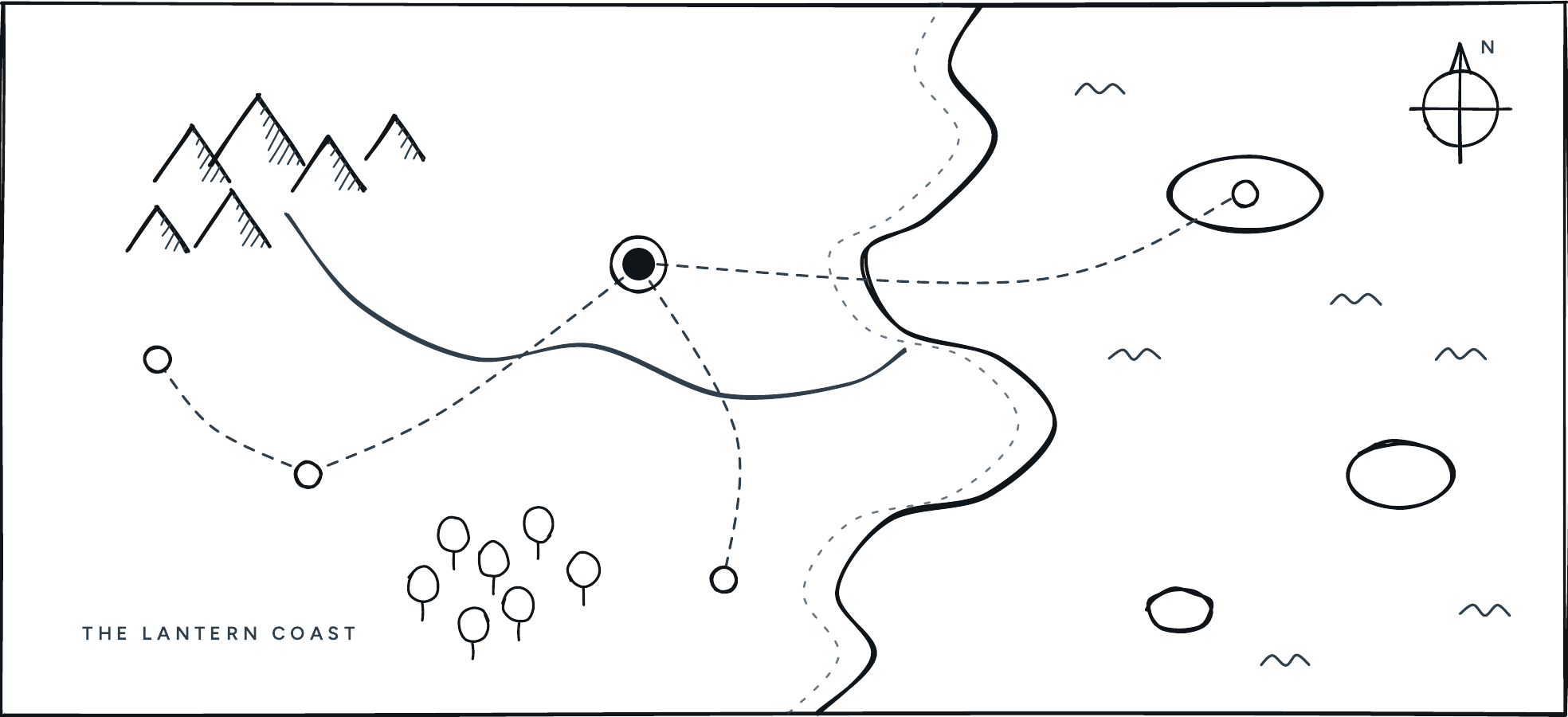
Prologue · The Lantern Coast
Imagine a webcomic artist whose fantasy world, the Lantern Coast, builds a devoted following. She keeps it in Bottega Studio from the first chapter.
Move your light across the map

01
Abstract
Worlds will now grow faster than they can be kept whole. Bottega is built to keep them whole.
Generative AI may be the most powerful creative tool in history. One person can now make in an afternoon what once took a studio months, and distribution is already instant.
Storyworlds will grow faster, across more media and more hands, than ever before. Yet the way a world is kept whole has barely changed. What is true in it, what was decided, what is allowed and who is owed still live in scattered files, separate contracts and a few people’s memories. Continuity now has to happen at the speed and scale of creation.
Fukui Labs is building Bottega to be the place where storyworlds are kept whole. Bottega Studio gives an IP owner one trusted, structured home for its world, with story and rights together, every fact traced to its source and every decision kept. Bottega then connects those worlds to the partners, builders and platforms that want to work with them, so that use, permission, credit and payment happen together.
Just as version control let thousands of engineers build one codebase without losing track of it, Bottega aims to let many hands build one world without losing what makes it whole.

02
A new era of storyworlds
Every new medium makes new worlds, and new ways to lose track of them. The signs are already here.
Photography unsettled painters. Within a few decades it also gave the world motion pictures, a medium nobody had planned for, and the studios, crafts and rules that grew up to organise it. Generative AI is a shift of the same kind. It drives down the cost of making images, voices, scenes, games and whole worlds, and it invites far more people to take part.
The signs are already here. Roblox reports that more than 80% of its top 100 games by hours engaged used AI to speed up creation, and that daily asset uploads tripled in a single month1. Roblox also lets IP owners license their worlds to its creators on terms the owners set, and reports more than 1,500 licence requests2. Fortnite lets creators publish islands where players talk with well-known characters through AI, with consistent voices and personas, some locked so creators cannot change them, and with the agreement of the actors whose voices are used3.
Great worlds were made by many hands long before AI. Star Wars grew across decades of films, books, comics and games, kept in order by a continuity database Lucasfilm began in 20004. In 2014 Lucasfilm moved most of that expanded universe to “Legends” and formed a story group to coordinate canon5. Starlight Runner, which built story bibles for Halo and Tron, says it plainly: “A successful bible will never be completed”6. And contracts split worlds as often as stories do. Harry Bosch and Mickey Haller are half-brothers in Michael Connelly’s novels, yet their screen versions sit with different streamers and cannot appear together.
AI will turn what was once the problem of a few giant franchises into the everyday condition of every world that matters. Yet the way worlds are kept whole was built for a slower age. Story knowledge lives in bibles and a few people’s memories, rights live in contracts and rights systems, and decisions live in email threads. As David Sugg, who led media supply chain engineering at Warner Bros., wrote of studio operations: “None of that knowledge is in a system”7. Every new participant, whether a writers’ room, a game studio, a licensee or an AI tool, rebuilds context and permission by hand.
More creation alone does not mean more value; attention, trust and commercial success stay scarce. What turns abundance into growth is making it cheap and safe for each new participant to work from the real world, with the owner’s approval. Before the next era of storytelling can reach its potential, worlds need infrastructure that keeps them whole at the speed they now grow, and that lets the people who build them be credited and paid.
The signs are already here · drag the cards, tap a seal for its source
03
Four requirements for continuity under abundance
What is true. What was decided. What is allowed. Who is owed.


To keep a world whole while many hands build in it, four things are needed.
First, a living source of what is true. A world needs facts tied to their sources: what each one says, which continuity or adaptation it belongs to, when in story time it holds, and whether the owner has approved it. It must tell a character’s belief from an established fact, and keep versions linked rather than flattened into one answer.
Second, a memory of what was decided. Every canon call needs its authority, its reasons, the version it applies to and what it replaces. Older systems often kept where an item ranked but not why; the reasons lived in someone’s memory. Unresolved conflicts and exceptions need to be kept as well, so the next person does not reopen them blind.
Third, permissions a machine can read. For any request (this element, this version, this purpose, this medium, this territory, this period), the owner’s approved rules should return allow, deny or needs review, tied to the agreement behind them. Today rights clearance, in Andy Beach’s words, “has never been a database. It has always been a research process”8.
Fourth, a clear path from use to the people owed. Contribution, credit, ownership, what a contract entitles and what is actually paid are different things. The infrastructure has to keep them apart, so that when a world is used, the right people are credited and the right obligations are calculated and settled.
Across all four, change has to travel. When something in the world changes, the affected work and partners need to know, and their response needs to be kept. That is what turns stored knowledge into a working process.

04
Introducing Bottega
A maintained world, and the moments that draw on it.
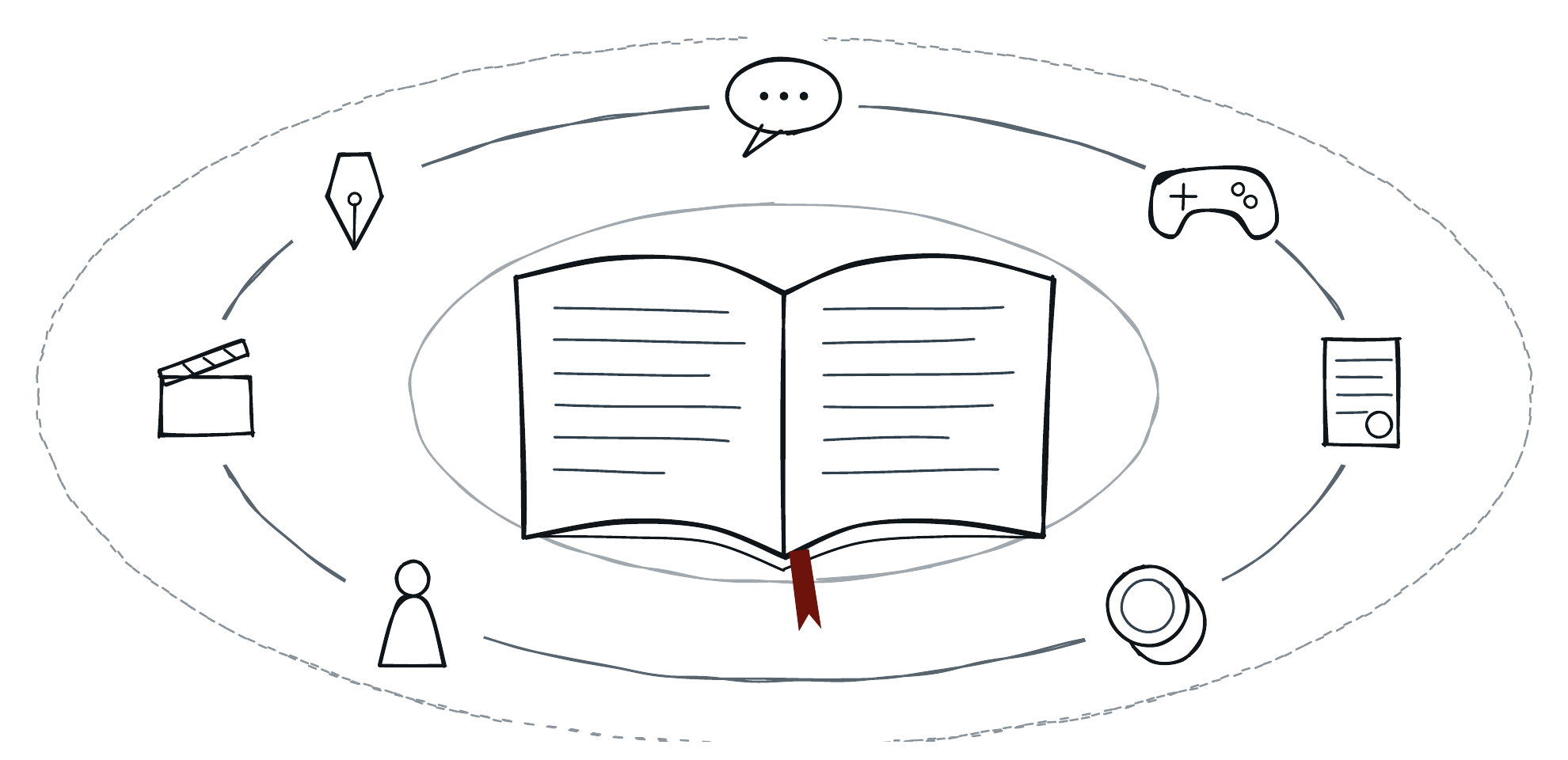
Bottega helps storyworlds grow by keeping them whole. It has two layers. Bottega Studio is where an IP owner keeps its world: story and rights together, every fact traced to its source, every decision kept with its reasons, and the owner’s people deciding what is canon and who may use what. Bottega is where those worlds meet the partners, builders and platforms that want to work with them.
Just as Git let engineers track code through branches and versions, and GitHub added the collaboration around it, Bottega Studio keeps a world’s versions and decisions, and Bottega adds the packages, approvals and partnerships that let others build on it.
Try it · a maintained world and its moments of use
Tap a moment of use to see what it draws on. Then let a change happen to the world.
The maintained world
Moments of use
Record
- Nothing asked yet.
The world and its moments of use
Bottega is built from two kinds of things. The first is the maintained world: characters, places, objects, rules, timelines, versions, decisions, terms and credits, each with an ID, a source and an approval status. The second is the moments of use: onboarding a writers’ room, handing a package to a game studio, checking a licensee’s product, answering an AI tool’s request, reporting a sale. Each moment draws on the maintained world and leaves a record of what was asked, what was approved and what was delivered.
The maintained world answers the first two requirements: what is true and what was decided. The moments of use answer the second two: what is allowed for this request, and who is owed when it happens. When the world changes, the moments that depend on it are flagged, so change reaches the people it affects.
Built for the owner
The owner keeps its world. People decide; the system proposes. An owner’s world is not used to train models without a separate agreement, and an owner can leave with everything, including its history. Where worlds meet other platforms, the shared parts (how an element is named, the terms it carries, the record of each authorization and reported use) should be open, building on standards studios already use such as EIDR, MovieLabs, ODRL and C2PA. Others should be able to build compatible services. Bottega earns through the services it runs and the relationships it keeps, not by locking worlds in.

05
A thriving ecosystem of worlds
Three worlds. Three ways a shared base layer pays off.
Bottega is a base layer. The tools, packages and partnerships built on it, by us, by partners and by outside builders, are what will make the next era of storyworlds real. Here is what that could look like.
Scenario 01
A franchise that keeps up
Imagine a publisher with a forty-year-old comics universe: thousands of issues, a film in production and a game in development. It brings the issues, scripts, art and contracts into Bottega Studio, and the world is structured once, with its own editors deciding what is canon. The film’s writers start from the storyworld instead of decades of back issues.
Then the director changes the origin of the universe’s best-known hero, Captain Vale. Bottega Studio keeps it as the film version, linked to the comics, not written over them. The game studio sees the change the same day, but its licensed comics continuity changes only if the publisher approves. When the publisher later launches an interactive Vale for fans, it defines which story moment he speaks from, what he must not spoil, how he may behave, and which voice and likeness permissions apply. Every partner works from the same world, and every change reaches the people it affects.
Scenario 02
Capturing value from AI abundance
Imagine a 19-year-old animator in Manila who makes a short film in which a starship captain from one series meets a dragon from another, using an AI video tool. Both owners keep their worlds on Bottega and have approved a fan-use template with a revenue share, so the tool checks the terms before it generates. The film is a hit. Credit appears automatically, the platform reports the views, and a share of the revenue is calculated for each owner and for the artists who first created the characters. Instead of a takedown notice, the animator gets an invitation to pitch an official short.
In this future, owners do not have to choose between fighting the wave of AI creation and giving their worlds away. They set the terms once, and the abundance of fan and creator work becomes reach, credit and revenue.
Scenario 03
A new world that grows with its people
Imagine a webcomic artist whose fantasy world, the Lantern Coast, builds a devoted following. She keeps it in Bottega Studio from the first chapter. Fans write stories within limits she sets, and when she marks one as canon, its writer is credited and earns a share. A small game studio finds the Lantern Coast on Bottega, sees exactly which version and uses she permits through a narrow, reusable licence, and ships a game without months of negotiation. A year later the same studio licenses a second world on Bottega and starts in days, because the process is already familiar. A producer looking for a fresh fantasy world for a limited series finds hers and opens a conversation.
One person’s world grows into a franchise without losing track of what is true, what was decided, what is allowed or who is owed. Each new owner makes Bottega more useful to partners, each new partner makes it more useful to owners, and deals that were too small to be worth a contract become practical.
Keep scrolling to walk past the three worlds


06
Bridging story and rights
Two rooms that have never shared a door.
For as long as there have been franchises, the story and the rights have lived in different rooms. The people who know the world rarely see the contracts, and the people who hold the contracts rarely see the world. That gap was manageable when worlds grew slowly and few outsiders took part.
It is not manageable now. Generative AI, interactive characters, participatory franchises and partners on every platform all need to know what is true in a world, what was decided, what is allowed and who is owed, and they need to know it at the speed they work. By bringing story and rights together under the owner’s control, Bottega lets worlds grow with the abundance of this new era instead of breaking under it.

The wave of creation is coming either way. The worlds that hold together will grow with it. We are building Bottega to keep them whole, for the people who made them, so that everyone else can build.
Manifesto · 2026

After the ride
Under
Abundance
Keep a copy
The manifesto as a 14-page PDF, the way it was printed.
Download the PDFPass it on
Send the link to someone who keeps a world.
Notes
- Roblox, Q3 2026 — https://www.sec.gov/Archives/edgar/data/1315098/000162828026068235/ex991-q32026earningsshar.htm
- Roblox, 2025 — https://about.roblox.com/newsroom/2025/11/roblox-self-serve-ip-licensing
- Epic, 2026 — https://www.fortnite.com/news/publish-islands-with-llm-conversations-starting-july-30
- Lucasfilm, 2012 — https://www.starwars.com/news/what-is-the-holocron
- Lucasfilm, 2014 — https://www.starwars.com/news/the-legendary-star-wars-expanded-universe-turns-a-new-page
- Kill Screen, 2013 — https://www.killscreen.com/inside-company-created-order-halo-splinter-cell-and-tron-universes/
- Engines of Change, 2026 — https://www.enginesofchange.ai/p/when-the-human-layer-is-the-control
- Engines of Change, 2026 — https://www.enginesofchange.ai/p/one-use-at-a-time
Fukui Labs, 2026. Set in Epilogue and Crimson Pro. The map of the Lantern Coast and the drawing of the open book are from the printed edition; the rooms were rendered for this one. Narration is read by Olivia, a synthetic voice from ElevenLabs; the sound is synthesized in your browser. This edition is read or scrolled; nothing in it is tracked beyond the page view.